Swallows in Washington
7 species of swallows have a mapped range in Washington. 3 are mapped across the whole state, among them the Cliff Swallow, the Northern Rough-winged Swallow and the Violet-green Swallow.
The most restricted is the Purple Martin, mapped in 12% of the state.
The heaviest is the Purple Martin, at 1.9 oz (54 g); the lightest is the Bank Swallow, at 0.4 oz (13 g).
The most species are mapped in Wahkiakum County (7); the fewest in Franklin County (5).
Open-licence records in the state that carry a month (3,298 of them) peak in May and are fewest in November.
The most often recorded is the Barn Swallow, with 1,209 open-licence records in the state.
- Cliff Swallow
- Northern Rough-winged Swallow
- Violet-green Swallow
- Barn Swallow
- Tree Swallow
- Bank Swallow
- Purple Martin
| Species | Size | Share of Washington | Active | Records | |
|---|---|---|---|---|---|
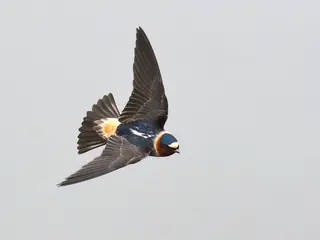 | Cliff Swallow summer Petrochelidon pyrrhonota Hirundinidae | 0.8 oz (22 g) | all | day | 375 |
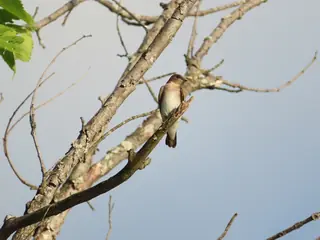 | Northern Rough-winged Swallow summer Stelgidopteryx serripennis Hirundinidae | 0.6 oz (16 g) | all | day | 255 |
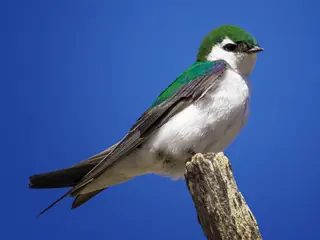 | Violet-green Swallow summer Tachycineta thalassina Hirundinidae | 0.5 oz (14 g) | all | day | 978 |
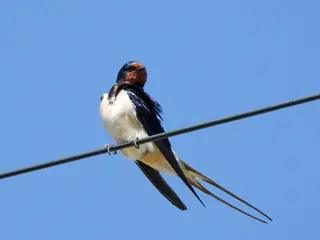 | Barn Swallow summer Hirundo rustica Hirundinidae | 0.6 oz (18 g) | 99% | day | 1,209 |
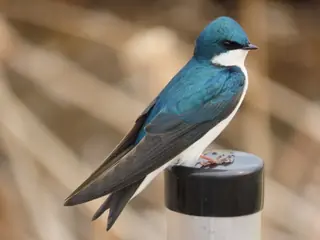 | Tree Swallow summer Tachycineta bicolor Hirundinidae | 0.7 oz (21 g) | 92% | day | 624 |
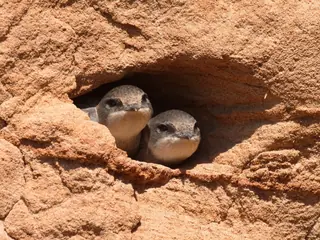 | Bank Swallow summer Riparia riparia Hirundinidae | 0.4 oz (13 g) | 82% | day | 188 |
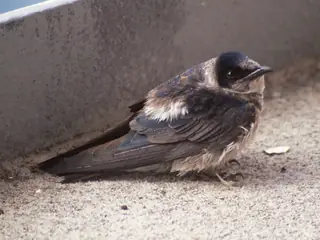 | Purple Martin summer Progne subis Hirundinidae | 1.9 oz (54 g) | 12% | day | 321 |
Share of Washington is the part of the state inside the species' USGS range map. Size is the largest on record where the source gives a maximum, otherwise a typical adult. Records are open-licence observations and specimens in the state, with eBird left out; a blank means none were counted, not that the species is absent. "Recorded" marks a species with no USGS range here that open records place in the state (ten or more, in three or more years).
More Washington lists
Other groups in Washington
Swallows in nearby states
Sources
- AVONET: morphological ecological and geographical data for all birds. CC BY 4.0. Read 2026-11-15.
- EltonTraits 1.0. CC0. Read 2026-11-15.
- GBIF Backbone Taxonomy. CC BY 4.0. Read 2026-11-15.
- GBIF occurrence records under CC0 and CC BY 4.0. CC0 and CC BY 4.0 per record. Read 2026-11-16.
- US Census Bureau cartographic boundary files 2023. Public domain (US Census Bureau). Read 2026-11-15.
- USGS GAP 12-digit hydrologic unit range units. Public domain (USGS). Read 2026-11-15.
- USGS Gap Analysis Project Species Range Maps CONUS_2001. Public domain (USGS). Read 2026-11-15.
- iNaturalist photographs under CC0 and CC BY. CC0 and CC BY per photograph. Read 2026-11-15.
How each figure is derived is set out on the methods page.