Lizards in Nebraska
12 species of lizards have a mapped range in Nebraska. The most widespread is the Six-lined Racerunner, mapped across 92% of the state.
The most restricted is the Plateau Fence Lizard, mapped in under 1% of the state.
The heaviest is the Slender Glass Lizard, at 5.2 oz (148 g); the lightest is the Many-lined Skink, at 0.3 oz (8.9 g).
The most species are mapped in Morrill County (7); the fewest in Cedar County (1).
Open-licence records in the state that carry a month (1,145 of them) peak in June and are fewest in November.
The most often recorded is the Common Lesser Earless Lizard, with 420 open-licence records in the state.
They belong to 4 families; the largest here is Phrynosomatidae, with 6 species.
- 1
- 2 to 3
- 4
- 5 to 6
- 7
| Species | Size | Share of Nebraska | Active | Records | |
|---|---|---|---|---|---|
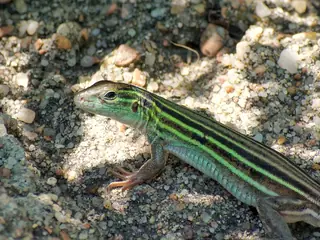 | Six-lined Racerunner Aspidoscelis sexlineatus Teiidae | 3.6 in (91 mm) snout to vent | 92% | day | 306 |
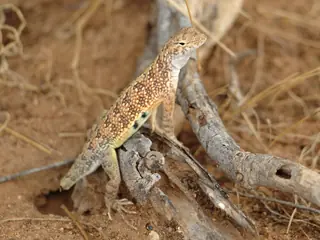 | Common Lesser Earless Lizard Holbrookia maculata Phrynosomatidae | 3.0 in (75 mm) snout to vent | 78% | day | 420 |
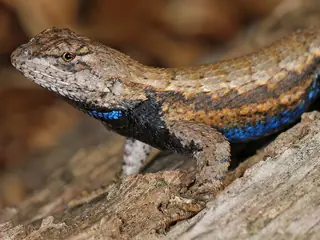 | Eastern Fence Lizard Sceloporus undulatus Phrynosomatidae | 3.6 in (91 mm) snout to vent | 63% | day | 274 |
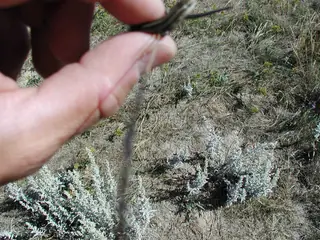 | Many-lined Skink Plestiodon multivirgatus Scincidae | 3.0 in (76 mm) snout to vent | 53% | day | 136 |
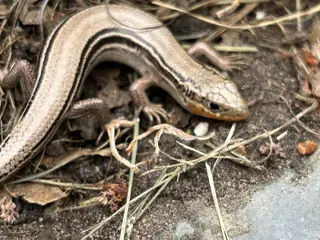 | Prairie Skink Plestiodon septentrionalis Scincidae | 3.5 in (90 mm) snout to vent | 43% | day | 117 |
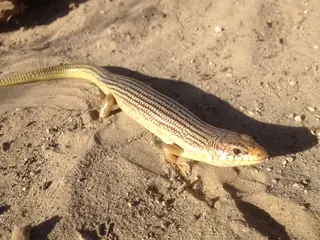 | Great Plains Skink Plestiodon obsoletus Scincidae | 5.6 in (143 mm) snout to vent | 26% | day | 85 |
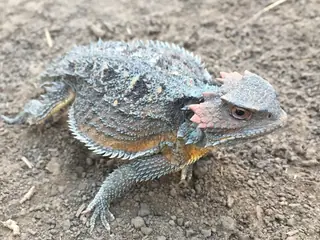 | Greater Short-horned Lizard Phrynosoma hernandesi Phrynosomatidae | 4.9 in (125 mm) snout to vent | 12% | day | 98 |
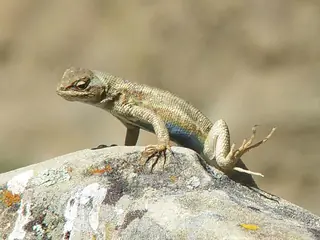 | Common Sagebrush Lizard Sceloporus graciosus Phrynosomatidae | 3.5 in (89 mm) snout to vent | 6% | day | 37 |
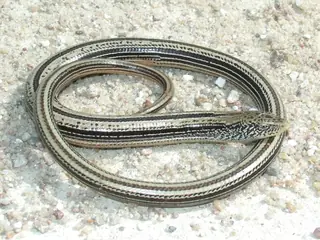 | Slender Glass Lizard Ophisaurus attenuatus Anguidae | 14 in (359 mm) snout to vent | 3% | day | 4 |
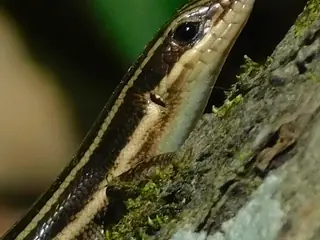 | Common Five-lined Skink Plestiodon fasciatus Scincidae | 3.4 in (86 mm) snout to vent | 1% | day | 12 |
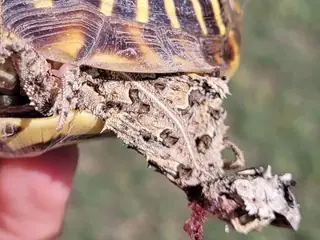 | Texas Horned Lizard Phrynosoma cornutum Phrynosomatidae | 5.1 in (130 mm) snout to vent | under 1% | day | |
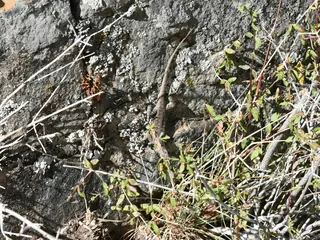 | Plateau Fence Lizard Sceloporus tristichus Phrynosomatidae | 3.7 in (95 mm) snout to vent | under 1% | day |
Share of Nebraska is the part of the state inside the species' USGS range map. Size is the largest on record where the source gives a maximum, otherwise a typical adult. Records are open-licence observations and specimens in the state; a blank means none were counted, not that the species is absent. "Recorded" marks a species with no USGS range here that open records place in the state (ten or more, in three or more years).
More Nebraska lists
Other groups in Nebraska
Lizards in nearby states
Sources
- GBIF Backbone Taxonomy. CC BY 4.0. Read 2026-11-15.
- GBIF occurrence records under CC0 and CC BY 4.0. CC0 and CC BY 4.0 per record. Read 2026-11-16.
- ReptTraits v1.2. CC BY 4.0. Read 2026-11-15.
- US Census Bureau cartographic boundary files 2023. Public domain (US Census Bureau). Read 2026-11-15.
- USGS GAP 12-digit hydrologic unit range units. Public domain (USGS). Read 2026-11-15.
- USGS Gap Analysis Project Species Range Maps CONUS_2001. Public domain (USGS). Read 2026-11-15.
- iNaturalist photographs under CC0 and CC BY. CC0 and CC BY per photograph. Read 2026-11-15.
How each figure is derived is set out on the methods page.