Cope's Giant Salamander
Dicamptodon copei
The Cope's Giant Salamander (Dicamptodon copei) is a salamander in the family Ambystomatidae. USGS maps its range in 2 of the lower 48 states, most widely in Washington, where it covers 16% of the state. Adults reach up to 7.5 in (191 mm) in body length.
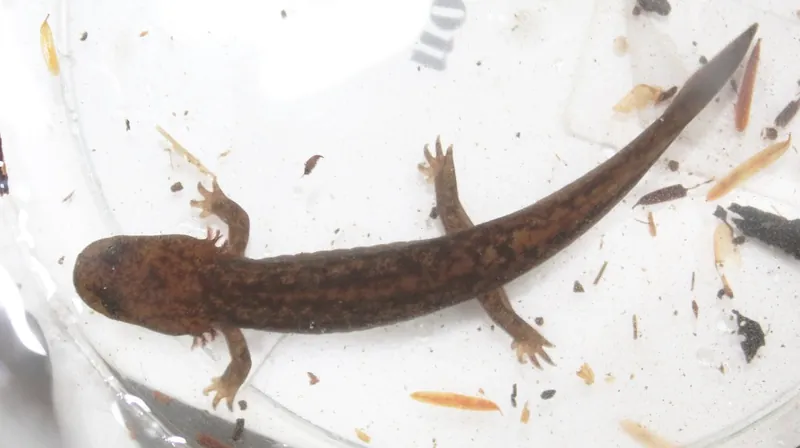
It lives on the ground and in water.
The USGS habitat model maps it in 17 land-cover types, among them North Pacific Dry-Mesic Silver Fir-Western Hemlock-Douglas-fir Forest, North Pacific Dry Douglas-fir-(Madrone) Forest and Woodland and North Pacific Lowland Mixed Hardwood-Conifer Forest and Woodland. The USGS habitat model keeps it within 60 m of flowing water or open water. The model places it no higher than 1,370 m (4,500 ft).
Open-licence records from the lower 48 (559 of them) peak in August and are fewest in January. A clutch can hold up to 115 eggs.
By size, range and water use in the USGS models, the species most easily taken for it are the Rough-skinned Newt, the Northwestern Salamander, the Dunn's Salamander and the Long-toed Salamander.
Where the Cope's Giant Salamander lives
| State | Share of state | Counties | Open records | Peak month |
|---|---|---|---|---|
| Washington | 16% | 10 of 39 | 768 | August |
| Oregon | 2% | 5 of 36 | 92 | August |
Share of state is the part of each state inside the range map. Counties counts those with at least a tenth of their area in range. A state link opens that state's full list.
When it is recorded
Species it can be taken for
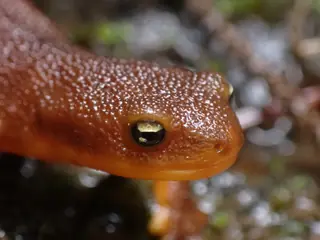
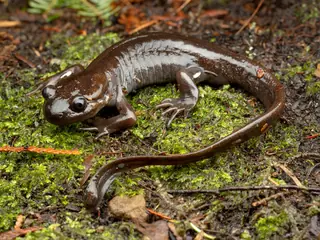
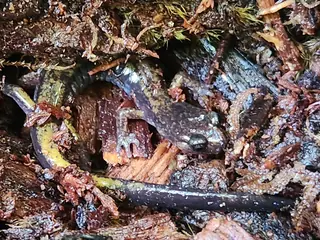
Chosen by rule: the same group, an adult size within 30%, at least one shared state and the same water use in the USGS habitat models. It is a list of candidates, not an identification.
Sources
- AmphiBIO v1. CC BY 4.0. Read 2026-11-15.
- GBIF Backbone Taxonomy. CC BY 4.0. Read 2026-11-15.
- GBIF occurrence records under CC0 and CC BY 4.0. CC0 and CC BY 4.0 per record. Read 2026-11-15.
- Integrated Taxonomic Information System. CC0. Read 2026-11-15.
- US Census Bureau cartographic boundary files 2023. Public domain (US Census Bureau). Read 2026-11-15.
- USGS GAP 12-digit hydrologic unit range units. Public domain (USGS). Read 2026-11-15.
- USGS Gap Analysis Project Species Habitat Maps CONUS_2001 (model parameters). Public domain (USGS). Read 2026-11-15.
- USGS Gap Analysis Project Species Range Maps CONUS_2001. Public domain (USGS). Read 2026-11-15.
- iNaturalist photographs under CC0 and CC BY. CC0 and CC BY per photograph. Read 2026-11-15.
How each figure is derived is set out on the methods page.