Frogs and toads in Florida
31 species of frogs and toads have a mapped range in Florida. 10 are mapped across the whole state, among them the Eastern Narrow-mouthed Toad, the Green Treefrog and the Southern Chorus Frog.
The most restricted is the Pickerel Frog, mapped in 2% of the state.
The longest is the Cane Toad, at 9.5 in (241 mm); the shortest is the Little Grass Frog, at 0.7 in (18 mm).
The most species are mapped in Santa Rosa County (26); the fewest in Broward County (17).
Open-licence records in the state that carry a month (28,800 of them) peak in April and are fewest in November.
The most often recorded is the Cuban Treefrog, with 5,763 open-licence records in the state.
By the trait records, 11 are active by day and by night and 8 are active at night.
They belong to 6 families; the largest here is Hylidae, with 15 species.
- 17 to 18
- 19 to 20
- 21 to 22
- 23 to 24
- 25 to 26
| Species | Size | Share of Florida | Active | Records | |
|---|---|---|---|---|---|
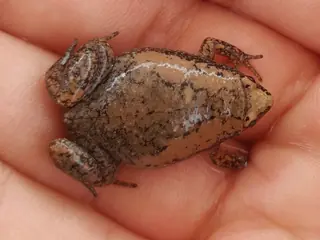 | Eastern Narrow-mouthed Toad Gastrophryne carolinensis Microhylidae | 1.5 in (38 mm) body | all | night | 1,516 |
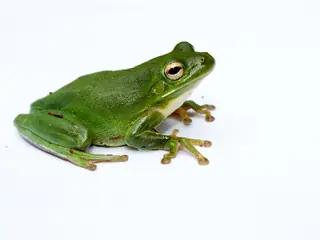 | Green Treefrog Dryophytes cinereus Hylidae | 2.6 in (66 mm) body | all | day and night | 2,945 |
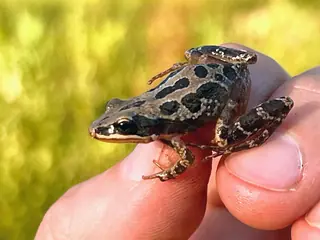 | Southern Chorus Frog Pseudacris nigrita Hylidae | 1.3 in (32 mm) body | all | day and night | 915 |
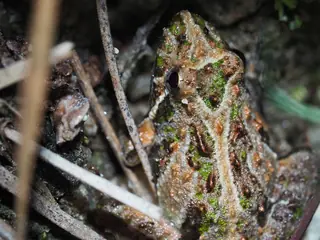 | Southern Cricket Frog Acris gryllus Hylidae | 1.3 in (32 mm) body | all | day and night | 2,899 |
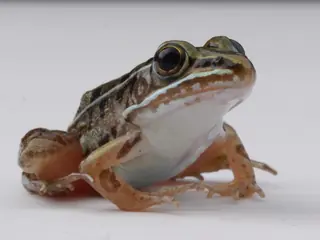 | Southern Leopard Frog Lithobates sphenocephalus Ranidae | 5.0 in (127 mm) body | all | 2,062 | |
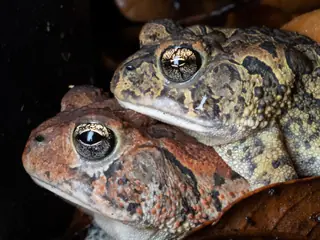 | Southern Toad Anaxyrus terrestris Bufonidae | 4.6 in (116 mm) body | all | 4,150 | |
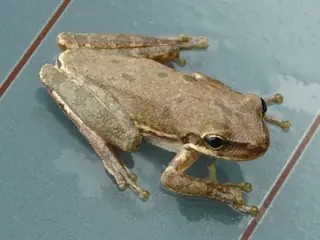 | Squirrel Treefrog Dryophytes squirellus Hylidae | 1.8 in (45 mm) body | all | night | 3,311 |
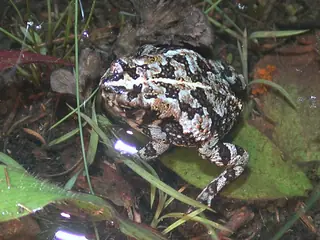 | Oak Toad Anaxyrus quercicus Bufonidae | 1.3 in (33 mm) body | all | 2,059 | |
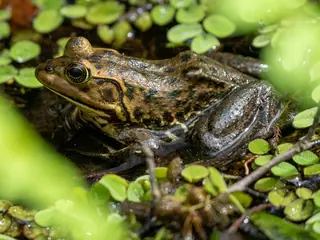 | Pig Frog Lithobates grylio Ranidae | 6.4 in (162 mm) body | all | 841 | |
| Pine Woods Treefrog Hyla femoralis Hylidae | 1.7 in (44 mm) body | all | day and night | 888 | |
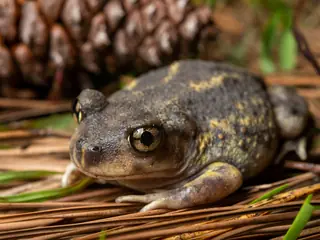 | Eastern Spadefoot Scaphiopus holbrookii Scaphiopodidae | 2.8 in (71 mm) body | 97% | night | 1,161 |
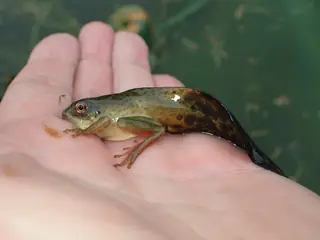 | Barking Treefrog Dryophytes gratiosus Hylidae | 2.8 in (70 mm) body | 96% | night | 559 |
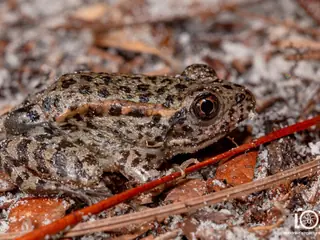 | Gopher Frog Lithobates capito Ranidae | 4.4 in (113 mm) body | 95% | 201 | |
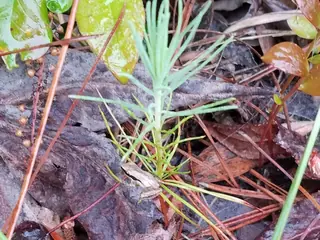 | Little Grass Frog Pseudacris ocularis Hylidae | 0.7 in (18 mm) body | 95% | day and night | 1,253 |
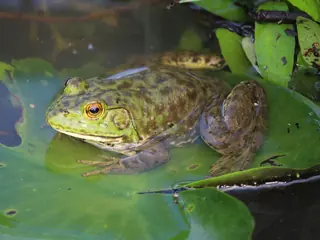 | American Bullfrog Lithobates catesbeianus Ranidae | 8.0 in (203 mm) body | 87% | day and night | 460 |
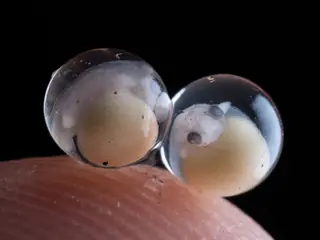 | Greenhouse Frog Eleutherodactylus planirostris Eleutherodactylidae | 1.4 in (36 mm) body | 85% | night | 1,354 |
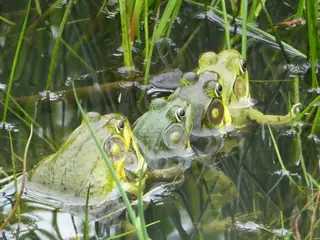 | Green Frog Lithobates clamitans Ranidae | 3.4 in (87 mm) body | 58% | day and night | 347 |
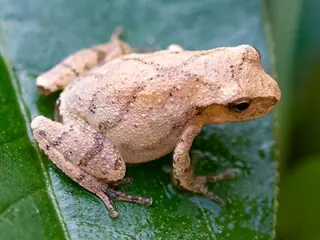 | Spring Peeper Pseudacris crucifer Hylidae | 1.5 in (37 mm) body | 57% | night | 252 |
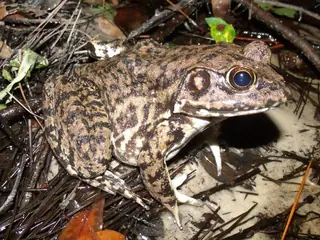 | River Frog Lithobates heckscheri Ranidae | 6.1 in (155 mm) body | 56% | 355 | |
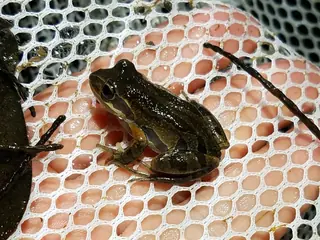 | Ornate Chorus Frog Pseudacris ornata Hylidae | 1.6 in (40 mm) body | 55% | night | 265 |
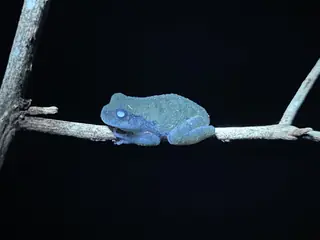 | Cope's Gray Treefrog Dryophytes chrysoscelis Hylidae | 2.4 in (62 mm) body | 48% | day and night | 447 |
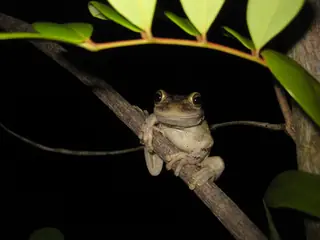 | Cuban Treefrog Osteopilus septentrionalis Hylidae | 6.5 in (165 mm) body | 29% | 5,763 | |
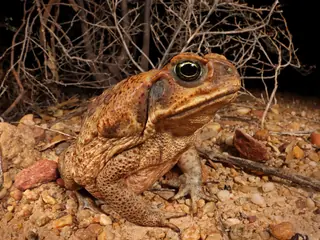 | Cane Toad Rhinella marina Bufonidae | 9.5 in (241 mm) body | 29% | day and night | 1,194 |
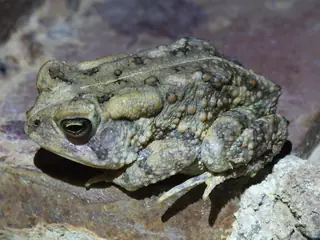 | Fowler's Toad Anaxyrus fowleri Bufonidae | 3.7 in (95 mm) body | 21% | 20 | |
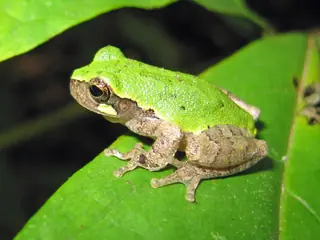 | Bird-voiced Treefrog Dryophytes avivoca Hylidae | 2.0 in (52 mm) body | 20% | night | 145 |
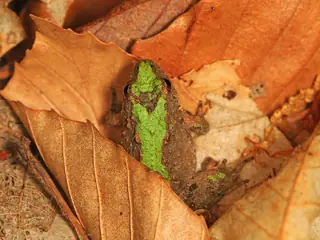 | Northern Cricket Frog Acris crepitans Hylidae | 1.5 in (38 mm) body | 15% | day and night | 22 |
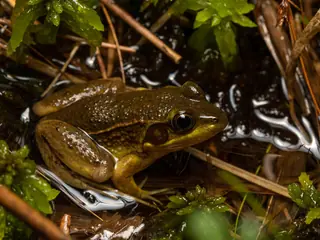 | Florida Bog Frog Lithobates okaloosae Ranidae | 2.0 in (50 mm) body | 6% | 26 | |
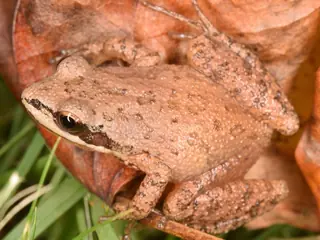 | Upland Chorus Frog Pseudacris feriarum Hylidae | 1.5 in (38 mm) body | 4% | day and night | 173 |
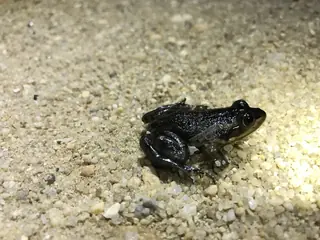 | Carpenter Frog Lithobates virgatipes Ranidae | 2.6 in (67 mm) body | 3% | ||
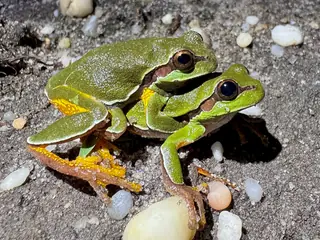 | Pine Barrens Treefrog Dryophytes andersonii Hylidae | 2.0 in (51 mm) body | 2% | 17 | |
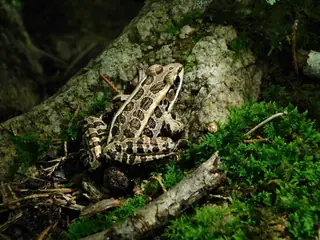 | Pickerel Frog Lithobates palustris Ranidae | 3.4 in (87 mm) body | 2% | 7 |
Share of Florida is the part of the state inside the species' USGS range map. Size is the largest on record where the source gives a maximum, otherwise a typical adult. Records are open-licence observations and specimens in the state; a blank means none were counted, not that the species is absent. "Recorded" marks a species with no USGS range here that open records place in the state (ten or more, in three or more years).
More Florida lists
Other groups in Florida
Frogs and toads in nearby states
Sources
- AmphiBIO v1. CC BY 4.0. Read 2026-11-15.
- GBIF Backbone Taxonomy. CC BY 4.0. Read 2026-11-15.
- GBIF occurrence records under CC0 and CC BY 4.0. CC0 and CC BY 4.0 per record. Read 2026-11-16.
- US Census Bureau cartographic boundary files 2023. Public domain (US Census Bureau). Read 2026-11-15.
- USGS GAP 12-digit hydrologic unit range units. Public domain (USGS). Read 2026-11-15.
- USGS Gap Analysis Project Species Range Maps CONUS_2001. Public domain (USGS). Read 2026-11-15.
- iNaturalist photographs under CC0 and CC BY. CC0 and CC BY per photograph. Read 2026-11-15.
How each figure is derived is set out on the methods page.