Bats in Wyoming
18 species of bats have a mapped range in Wyoming. 5 are mapped across the whole state, among them the Big Brown Bat, the Little Brown Myotis and the Silver-haired Bat.
The most restricted is the Eastern Pipistrelle, mapped in 1% of the state.
The heaviest is the Hoary Bat, at 0.9 oz (26 g); the lightest is the Western Pipistrelle, at 0.1 oz (3.6 g).
The most species are mapped in Sweetwater County (15); the fewest in Campbell County (8).
Open-licence records in the state that carry a month (1,107 of them) peak in August and are fewest in January.
The most often recorded is the Little Brown Myotis, with 416 open-licence records in the state.
They belong to 2 families; the largest here is Vespertilionidae, with 17 species.
- 8
- 9
- 10
- 11
- 12 to 15
| Species | Size | Share of Wyoming | Active | Records | |
|---|---|---|---|---|---|
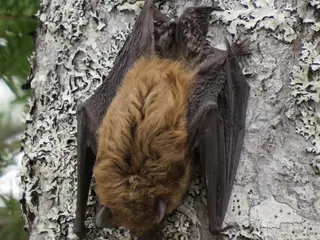 | Big Brown Bat Eptesicus fuscus Vespertilionidae | 3.0 in (75 mm) body | all | night | 124 |
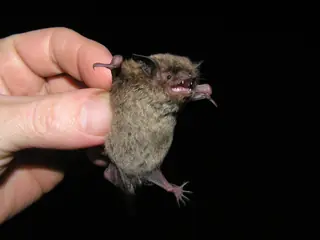 | Little Brown Myotis Myotis lucifugus Vespertilionidae | 2.1 in (53 mm) body | all | night | 416 |
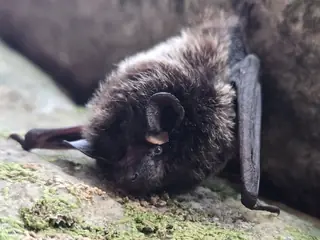 | Silver-haired Bat Lasionycteris noctivagans Vespertilionidae | 0.4 oz (11 g) | all | night | 57 |
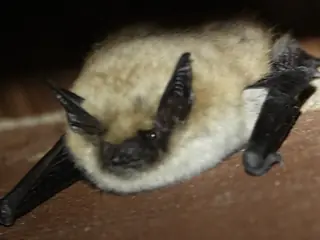 | Western Small-footed Myotis Myotis ciliolabrum Vespertilionidae | 2.1 in (53 mm) body | all | night | 228 |
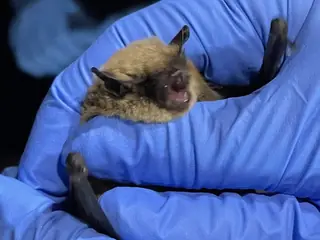 | Long-legged Myotis Myotis volans Vespertilionidae | 0.3 oz (7.9 g) | all | night | 98 |
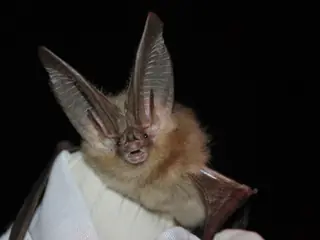 | Townsend's Big-eared Bat Corynorhinus townsendii Vespertilionidae | 2.3 in (58 mm) body | 95% | night | 44 |
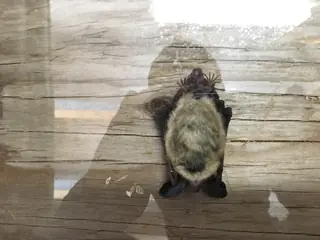 | Long-eared Myotis Myotis evotis Vespertilionidae | 0.3 oz (7.4 g) | 77% | night | 66 |
 | Fringed Myotis Myotis thysanodes Vespertilionidae | 2.1 in (54 mm) body | 77% | night | 16 |
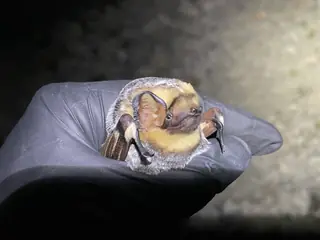 | Hoary Bat possible Aeorestes cinereus Vespertilionidae | 3.3 in (83 mm) body | 69% | night | 27 |
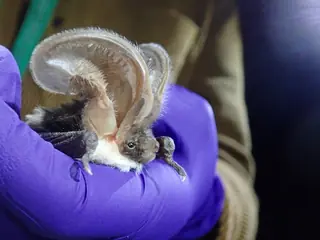 | Spotted Bat Euderma maculatum Vespertilionidae | 0.6 oz (16 g) | 33% | night | 3 |
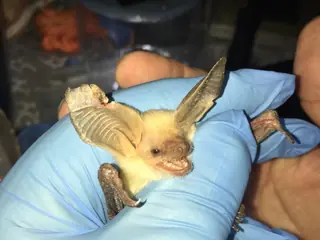 | Pallid Bat Antrozous pallidus Vespertilionidae | 0.8 oz (22 g) | 9% | night | 17 |
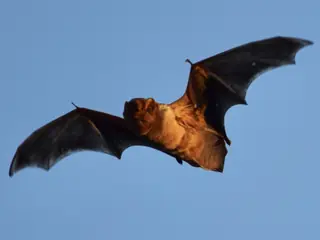 | Eastern Red Bat Lasiurus borealis Vespertilionidae | 0.5 oz (13 g) | 7% | night | 2 |
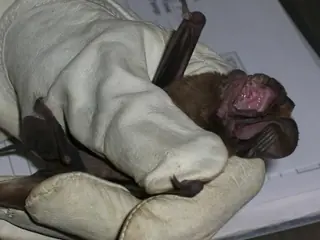 | Big Free-tailed Bat Nyctinomops macrotis Molossidae | 0.8 oz (23 g) | 4% | night | 1 |
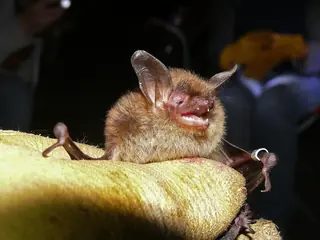 | Northern Myotis Myotis septentrionalis Vespertilionidae | 0.2 oz (6 g) | 3% | night | 5 |
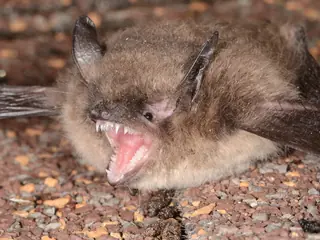 | Yuma Myotis Myotis yumanensis Vespertilionidae | 0.2 oz (5.9 g) | 3% | night | 13 |
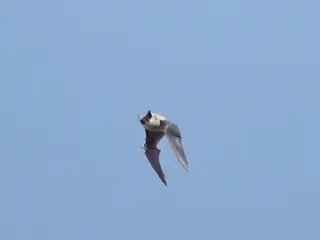 | Western Pipistrelle Parastrellus hesperus Vespertilionidae | 0.1 oz (3.6 g) | 2% | night | |
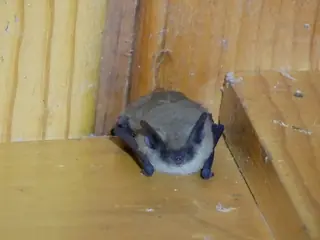 | Californian Myotis Myotis californicus Vespertilionidae | 2.1 in (53 mm) body | 2% | night | 13 |
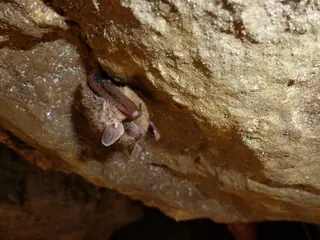 | Eastern Pipistrelle Perimyotis subflavus Vespertilionidae | 2.2 in (55 mm) body | 1% | night |
Share of Wyoming is the part of the state inside the species' USGS range map. Size is the largest on record where the source gives a maximum, otherwise a typical adult. Records are open-licence observations and specimens in the state; a blank means none were counted, not that the species is absent. "Recorded" marks a species with no USGS range here that open records place in the state (ten or more, in three or more years).
Other groups in Wyoming
Bats in nearby states
Sources
- COMBINE: a coalesced mammal database of intrinsic and extrinsic traits. CC BY 4.0. Read 2026-11-15.
- GBIF Backbone Taxonomy. CC BY 4.0. Read 2026-11-15.
- GBIF occurrence records under CC0 and CC BY 4.0. CC0 and CC BY 4.0 per record. Read 2026-11-16.
- US Census Bureau cartographic boundary files 2023. Public domain (US Census Bureau). Read 2026-11-15.
- USGS GAP 12-digit hydrologic unit range units. Public domain (USGS). Read 2026-11-15.
- USGS Gap Analysis Project Species Range Maps CONUS_2001. Public domain (USGS). Read 2026-11-15.
- iNaturalist photographs under CC0 and CC BY. CC0 and CC BY per photograph. Read 2026-11-15.
How each figure is derived is set out on the methods page.