Deer, elk and moose in California
4 species of deer, elk and moose have a mapped range in California. The most widespread is the Mule Deer, mapped across all of the state.
The most restricted is the Sambar, mapped in under 1% of the state.
The longest is the Sambar, at 7.4 ft (2,250 mm); the shortest is the Fallow Deer, at 5.7 ft (1,750 mm).
USGS marks 1 of them as introduced in the state: the Fallow Deer.
The most species are mapped in San Luis Obispo County (3); the fewest in Alpine County (1).
Open-licence records in the state that carry a month (14,856 of them) peak in August and are fewest in March.
The most often recorded is the Mule Deer, with 13,776 open-licence records in the state.
- Mule Deer
- Elk
- Fallow Deer
- Sambar
| Species | Size | Share of California | Active | Records | |
|---|---|---|---|---|---|
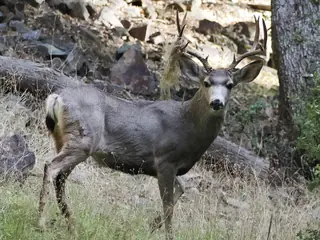 | Mule Deer Odocoileus hemionus Cervidae | 5.9 ft (1,808 mm) body | all | night | 13,776 |
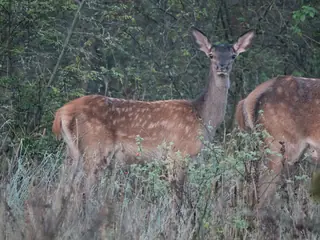 | Elk Cervus elaphus Cervidae | 7.0 ft (2,137 mm) body | 20% | night | 1,321 |
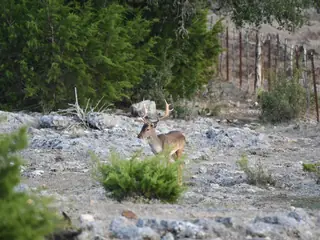 | Fallow Deer introduced Dama dama Cervidae | 5.7 ft (1,750 mm) body | under 1% | night | 31 |
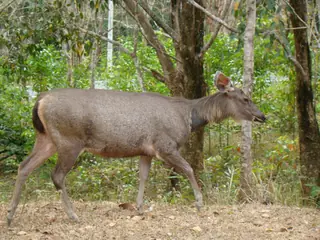 | Sambar Rusa unicolor Cervidae | 7.4 ft (2,250 mm) body | under 1% | night |
Share of California is the part of the state inside the species' USGS range map. Size is the largest on record where the source gives a maximum, otherwise a typical adult. Records are open-licence observations and specimens in the state; a blank means none were counted, not that the species is absent. "Recorded" marks a species with no USGS range here that open records place in the state (ten or more, in three or more years).
More California lists
Other groups in California
Deer, elk and moose in nearby states
Sources
- COMBINE: a coalesced mammal database of intrinsic and extrinsic traits. CC BY 4.0. Read 2026-11-15.
- EltonTraits 1.0. CC0. Read 2026-11-15.
- GBIF Backbone Taxonomy. CC BY 4.0. Read 2026-11-15.
- GBIF occurrence records under CC0 and CC BY 4.0. CC0 and CC BY 4.0 per record. Read 2026-11-16.
- US Census Bureau cartographic boundary files 2023. Public domain (US Census Bureau). Read 2026-11-15.
- USGS GAP 12-digit hydrologic unit range units. Public domain (USGS). Read 2026-11-15.
- USGS Gap Analysis Project Species Range Maps CONUS_2001. Public domain (USGS). Read 2026-11-15.
- iNaturalist photographs under CC0 and CC BY. CC0 and CC BY per photograph. Read 2026-11-15.
How each figure is derived is set out on the methods page.