Rattlesnakes in Colorado
3 species of rattlesnakes have a mapped range in Colorado. The venomous species are the Prairie Rattlesnake, the Massasauga and the Western Rattlesnake. All belong to the groups the CDC lists for the United States (rattlesnakes, copperheads, cottonmouths and coral snakes).
The most widespread is the Prairie Rattlesnake, mapped across 75% of the state.
The most restricted is the Western Rattlesnake, mapped in under 1% of the state.
The longest is the Prairie Rattlesnake, at 5.4 ft (1,650 mm); the shortest is the Massasauga, at 3.4 ft (1,030 mm).
The most species are mapped in Pueblo County (2); the fewest in Chaffee County (0).
Open-licence records in the state (1,919 of them) peak in May and are fewest in February.
By the trait records, 2 are active at night and 1 is active by day.
- Prairie Rattlesnake
- Massasauga
- Western Rattlesnake
| Species | Size | Share of Colorado | Active | Records | |
|---|---|---|---|---|---|
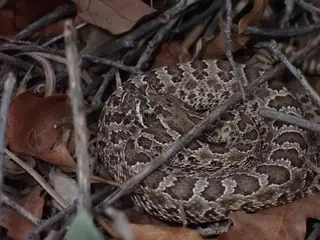 | Prairie Rattlesnake venomous Crotalus viridis Viperidae | 5.4 ft (1,650 mm) | 75% | night | 1,955 |
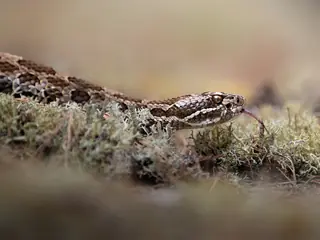 | Massasauga venomous Sistrurus catenatus Viperidae | 3.4 ft (1,030 mm) | 14% | day | 8 |
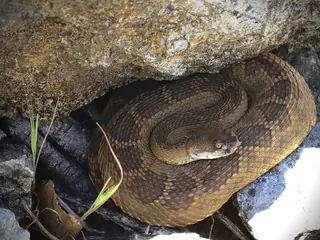 | Western Rattlesnake venomous Crotalus oreganus Viperidae | 5.3 ft (1,625 mm) | under 1% | night | 83 |
Share of Colorado is the part of the state inside the species' USGS range map. Size is the largest on record where the source gives a maximum, otherwise a typical adult. Records are open-licence observations and specimens in the state; a blank means none were counted, not that the species is absent.
More Colorado lists
Other groups in Colorado
Rattlesnakes in nearby states
Sources
- CDC NIOSH venomous snakes and venomous spiders pages. Public domain (CDC). Read 2026-11-15.
- GBIF Backbone Taxonomy. CC BY 4.0. Read 2026-11-15.
- GBIF occurrence records under CC0 and CC BY 4.0. CC0 and CC BY 4.0 per record. Read 2026-11-15.
- ReptTraits v1.2. CC BY 4.0. Read 2026-11-15.
- US Census Bureau cartographic boundary files 2023. Public domain (US Census Bureau). Read 2026-11-15.
- USGS GAP 12-digit hydrologic unit range units. Public domain (USGS). Read 2026-11-15.
- USGS Gap Analysis Project Species Range Maps CONUS_2001. Public domain (USGS). Read 2026-11-15.
- iNaturalist photographs under CC0 and CC BY. CC0 and CC BY per photograph. Read 2026-11-15.
How each figure is derived is set out on the methods page.