Bats in New Mexico
30 species of bats have a mapped range in New Mexico. 8 are mapped across the whole state, among them the Big Brown Bat, the Hoary Bat and the Mexican Free-tailed Bat.
The most restricted is the Eastern Pipistrelle, mapped in under 1% of the state.
The longest is the Greater Bonneted Bat, at 4.9 in (125 mm); the shortest is the Arizona Myotis, at 2.1 in (53 mm).
The most species are mapped in Hidalgo County (25); the fewest in Curry County (10).
Open-licence records in the state that carry a month (14,417 of them) peak in June and are fewest in February.
The most often recorded is the Mexican Free-tailed Bat, with 1,728 open-licence records in the state.
They belong to 3 families; the largest here is Vespertilionidae, with 22 species.
- 10 to 11
- 12 to 15
- 16 to 17
- 18 to 19
- 20 to 25
| Species | Size | Share of New Mexico | Active | Records | |
|---|---|---|---|---|---|
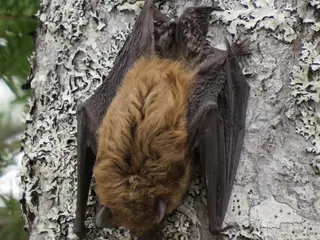 | Big Brown Bat Eptesicus fuscus Vespertilionidae | 3.0 in (75 mm) body | all | night | 1,409 |
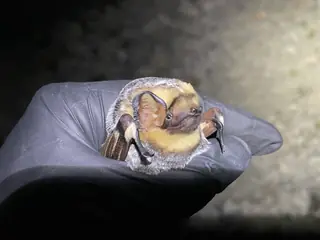 | Hoary Bat Aeorestes cinereus Vespertilionidae | 3.3 in (83 mm) body | all | night | 1,194 |
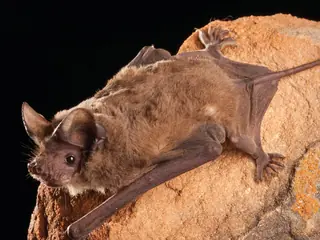 | Mexican Free-tailed Bat Tadarida brasiliensis Molossidae | 3.6 in (91 mm) body | all | night | 1,728 |
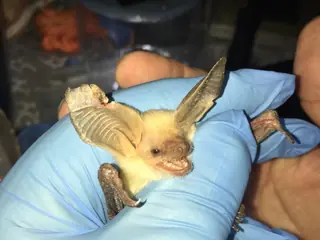 | Pallid Bat Antrozous pallidus Vespertilionidae | 0.8 oz (22 g) | all | night | 1,435 |
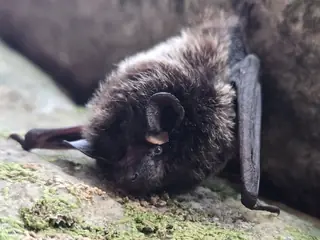 | Silver-haired Bat Lasionycteris noctivagans Vespertilionidae | 0.4 oz (11 g) | all | night | 981 |
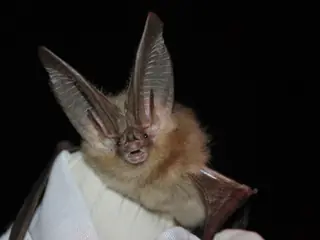 | Townsend's Big-eared Bat Corynorhinus townsendii Vespertilionidae | 2.3 in (58 mm) body | all | night | 521 |
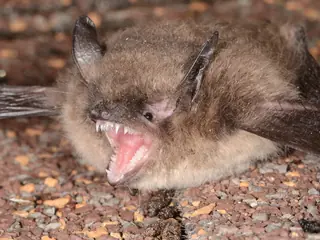 | Yuma Myotis Myotis yumanensis Vespertilionidae | 0.2 oz (5.9 g) | all | night | 575 |
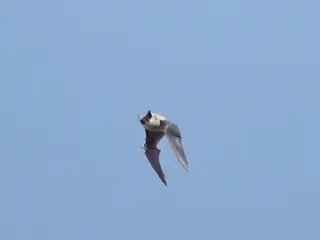 | Western Pipistrelle Parastrellus hesperus Vespertilionidae | 0.1 oz (3.6 g) | all | night | 881 |
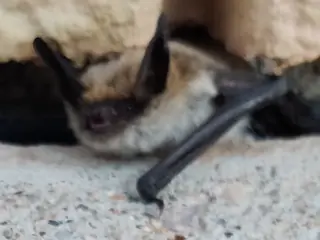 | Fringed Myotis Myotis thysanodes Vespertilionidae | 2.1 in (54 mm) body | 95% | night | 1,149 |
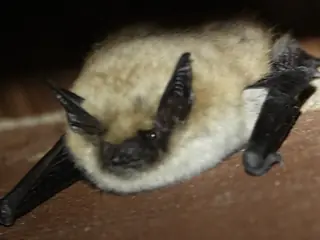 | Western Small-footed Myotis Myotis ciliolabrum Vespertilionidae | 2.1 in (53 mm) body | 90% | night | 666 |
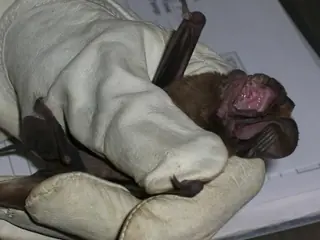 | Big Free-tailed Bat Nyctinomops macrotis Molossidae | 0.8 oz (23 g) | 82% | night | 98 |
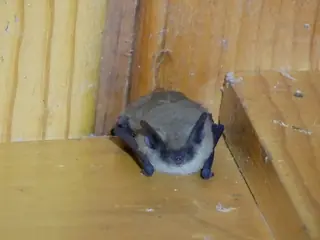 | Californian Myotis Myotis californicus Vespertilionidae | 2.1 in (53 mm) body | 78% | night | 508 |
| Arizona Myotis Myotis occultus Vespertilionidae | 2.1 in (53 mm) body | 78% | night | 509 | |
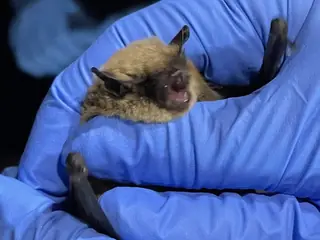 | Long-legged Myotis Myotis volans Vespertilionidae | 0.3 oz (7.9 g) | 77% | night | 1,180 |
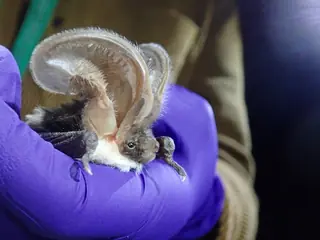 | Spotted Bat Euderma maculatum Vespertilionidae | 0.6 oz (16 g) | 60% | night | 39 |
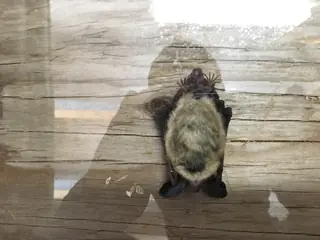 | Long-eared Myotis Myotis evotis Vespertilionidae | 0.3 oz (7.4 g) | 51% | night | 536 |
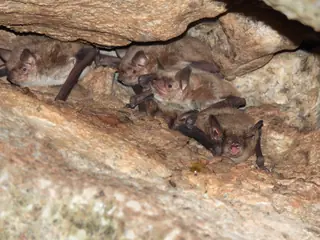 | Cave Myotis Myotis velifer Vespertilionidae | 2.6 in (65 mm) body | 36% | night | 723 |
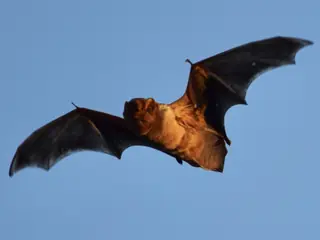 | Eastern Red Bat Lasiurus borealis Vespertilionidae | 0.5 oz (13 g) | 27% | night | 116 |
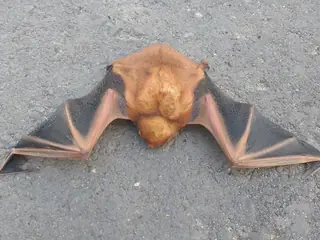 | Western Red Bat Lasiurus blossevillii Vespertilionidae | 2.6 in (65 mm) body | 25% | night | 38 |
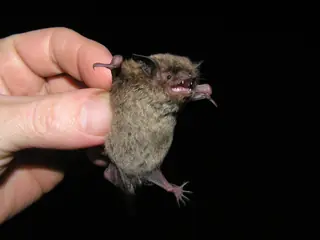 | Little Brown Myotis Myotis lucifugus Vespertilionidae | 2.1 in (53 mm) body | 20% | night | 152 |
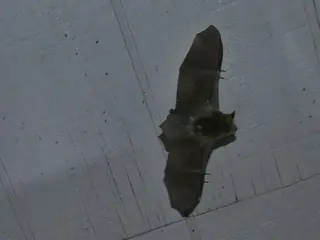 | Southwestern Myotis Myotis auriculus Vespertilionidae | 2.1 in (54 mm) body | 15% | night | 309 |
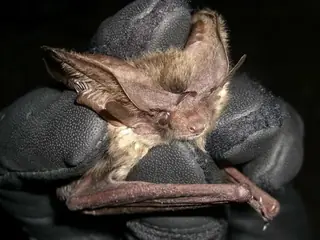 | Allen's Big-eared Bat Idionycteris phyllotis Vespertilionidae | 2.3 in (59 mm) body | 14% | night | 101 |
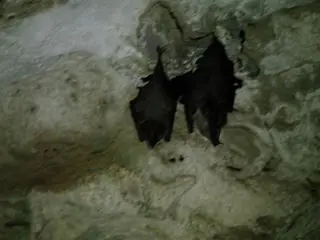 | Curasoan Long-nosed Bat Leptonycteris curasoae Phyllostomidae | 3.4 in (86 mm) body | 4% | night | 31 |
 | Mexican Long-nosed Bat Leptonycteris nivalis Phyllostomidae | 3.7 in (93 mm) body | 4% | night | 5 |
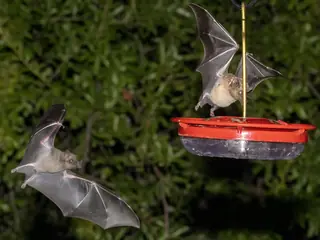 | Mexican Long-tongued Bat Choeronycteris mexicana Phyllostomidae | 3.1 in (80 mm) body | 4% | night | 36 |
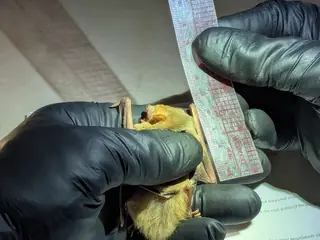 | Western Yellow Bat Dasypterus xanthinus Vespertilionidae | 3.0 in (75 mm) body | 3% | night | 11 |
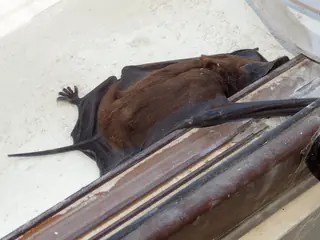 | Greater Bonneted Bat Eumops perotis Molossidae | 4.9 in (125 mm) body | 3% | night | 3 |
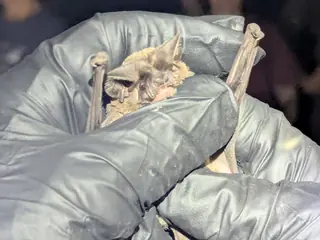 | Pocketed Free-tailed Bat Nyctinomops femorosaccus Molossidae | 0.5 oz (14 g) | 2% | night | 13 |
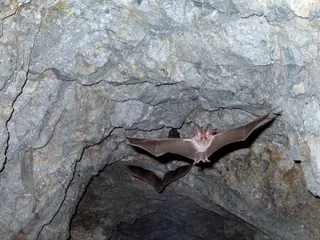 | Californian Leaf-nosed Bat Macrotus californicus Phyllostomidae | 2.5 in (63 mm) body | 2% | night | |
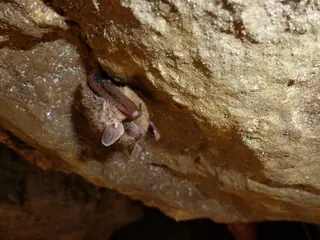 | Eastern Pipistrelle Perimyotis subflavus Vespertilionidae | 2.2 in (55 mm) body | under 1% | night | 5 |
Share of New Mexico is the part of the state inside the species' USGS range map. Size is the largest on record where the source gives a maximum, otherwise a typical adult. Records are open-licence observations and specimens in the state; a blank means none were counted, not that the species is absent. "Recorded" marks a species with no USGS range here that open records place in the state (ten or more, in three or more years).
Other groups in New Mexico
Bats in nearby states
Sources
- COMBINE: a coalesced mammal database of intrinsic and extrinsic traits. CC BY 4.0. Read 2026-11-15.
- GBIF Backbone Taxonomy. CC BY 4.0. Read 2026-11-15.
- GBIF occurrence records under CC0 and CC BY 4.0. CC0 and CC BY 4.0 per record. Read 2026-11-16.
- US Census Bureau cartographic boundary files 2023. Public domain (US Census Bureau). Read 2026-11-15.
- USGS GAP 12-digit hydrologic unit range units. Public domain (USGS). Read 2026-11-15.
- USGS Gap Analysis Project Species Range Maps CONUS_2001. Public domain (USGS). Read 2026-11-15.
- iNaturalist photographs under CC0 and CC BY. CC0 and CC BY per photograph. Read 2026-11-15.
How each figure is derived is set out on the methods page.