Lizards in Oregon
12 species of lizards have a mapped range in Oregon. The most widespread is the Western Fence Lizard, mapped across 90% of the state.
The most restricted is the Plateau Striped Whiptail, mapped in under 1% of the state.
The heaviest is the Southern Alligator Lizard, at 4.1 oz (118 g); the lightest is the Western Skink, at 0.5 oz (13 g).
USGS marks 1 of them as introduced in the state: the Plateau Striped Whiptail.
The most species are mapped in Lake County (10); the fewest in Tillamook County (1).
Open-licence records in the state that carry a month (5,037 of them) peak in June and are fewest in December.
The most often recorded is the Western Fence Lizard, with 1,890 open-licence records in the state.
By the trait records, 11 are active by day and 1 is active by day and by night.
They belong to 5 families; the largest here is Phrynosomatidae, with 5 species.
- 1 to 2
- 3 to 4
- 5 to 6
- 7 to 8
- 9 to 10
| Species | Size | Share of Oregon | Active | Records | |
|---|---|---|---|---|---|
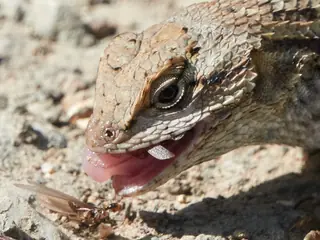 | Western Fence Lizard Sceloporus occidentalis Phrynosomatidae | 3.9 in (99 mm) snout to vent | 90% | day | 1,890 |
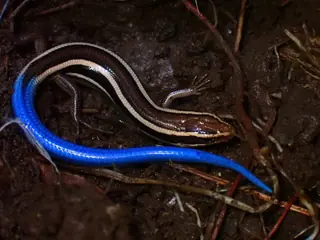 | Western Skink Plestiodon skiltonianus Scincidae | 3.4 in (86 mm) snout to vent | 84% | day | 447 |
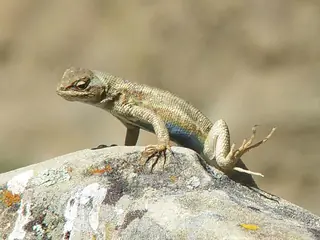 | Common Sagebrush Lizard Sceloporus graciosus Phrynosomatidae | 3.5 in (89 mm) snout to vent | 65% | day | 528 |
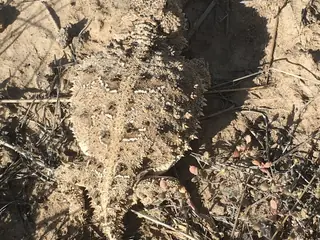 | Pygmy Short-horned Lizard Phrynosoma douglasii Phrynosomatidae | 3.1 in (80 mm) snout to vent | 64% | day | 617 |
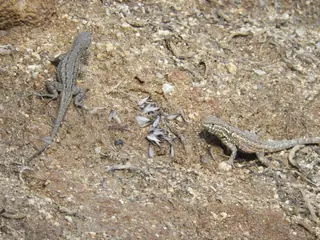 | Common Side-blotched Lizard Uta stansburiana Phrynosomatidae | 3.0 in (77 mm) snout to vent | 51% | day | 466 |
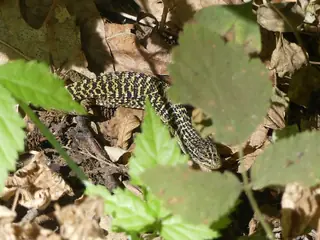 | Northern Alligator Lizard Elgaria coerulea Anguidae | 5.4 in (136 mm) snout to vent | 46% | day | 931 |
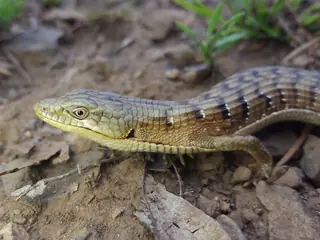 | Southern Alligator Lizard Elgaria multicarinata Anguidae | 7.0 in (178 mm) snout to vent | 35% | day and night | 380 |
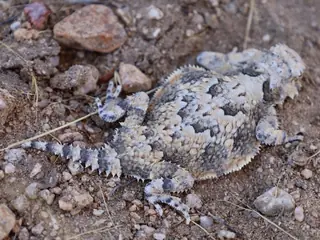 | Desert Horned Lizard Phrynosoma platyrhinos Phrynosomatidae | 3.7 in (95 mm) snout to vent | 30% | day | 78 |
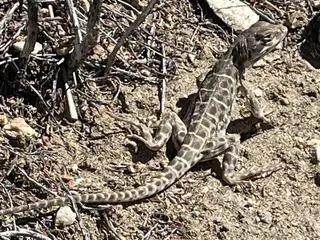 | Long-nosed Leopard Lizard Gambelia wislizenii Crotaphytidae | 5.7 in (146 mm) snout to vent | 23% | day | 171 |
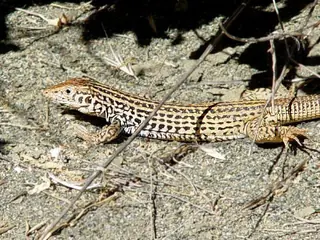 | Tiger Whiptail Aspidoscelis tigris Teiidae | 5.4 in (137 mm) snout to vent | 18% | day | 189 |
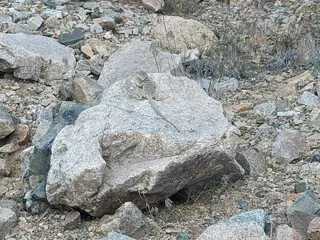 | Great Basin Collared Lizard Crotaphytus bicinctores Crotaphytidae | 4.6 in (117 mm) snout to vent | 14% | day | 17 |
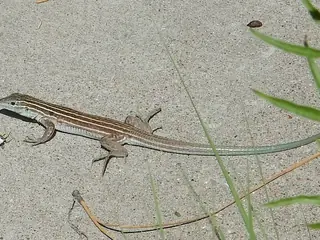 | Plateau Striped Whiptail introduced Aspidoscelis velox Teiidae | 3.5 in (89 mm) snout to vent | under 1% | day | 6 |
Share of Oregon is the part of the state inside the species' USGS range map. Size is the largest on record where the source gives a maximum, otherwise a typical adult. Records are open-licence observations and specimens in the state; a blank means none were counted, not that the species is absent. "Recorded" marks a species with no USGS range here that open records place in the state (ten or more, in three or more years).
Other groups in Oregon
Lizards in nearby states
Sources
- GBIF Backbone Taxonomy. CC BY 4.0. Read 2026-11-15.
- GBIF occurrence records under CC0 and CC BY 4.0. CC0 and CC BY 4.0 per record. Read 2026-11-16.
- ReptTraits v1.2. CC BY 4.0. Read 2026-11-15.
- US Census Bureau cartographic boundary files 2023. Public domain (US Census Bureau). Read 2026-11-15.
- USGS GAP 12-digit hydrologic unit range units. Public domain (USGS). Read 2026-11-15.
- USGS Gap Analysis Project Species Range Maps CONUS_2001. Public domain (USGS). Read 2026-11-15.
- iNaturalist photographs under CC0 and CC BY. CC0 and CC BY per photograph. Read 2026-11-15.
How each figure is derived is set out on the methods page.