True frogs in Oregon
7 species of true frogs have a mapped range in Oregon. The most widespread is the American Bullfrog, mapped across 73% of the state.
The most restricted is the Oregon Spotted Frog, mapped in 7% of the state.
The longest is the American Bullfrog, at 8.0 in (203 mm); the shortest is the Foothill Yellow-legged Frog, at 2.9 in (73 mm).
USGS marks 1 of them as introduced in the state: the American Bullfrog.
The most species are mapped in Wasco County (5); the fewest in Benton County (2).
Open-licence records in the state that carry a month (3,373 of them) peak in July and are fewest in January.
The most often recorded is the Northern Red-legged Frog, with 1,030 open-licence records in the state.
- American Bullfrog
- Columbia Spotted Frog
- Northern Red-legged Frog
- Foothill Yellow-legged Frog
- Cascades Frog
- Northern Leopard Frog
- Oregon Spotted Frog
| Species | Size | Share of Oregon | Active | Records | |
|---|---|---|---|---|---|
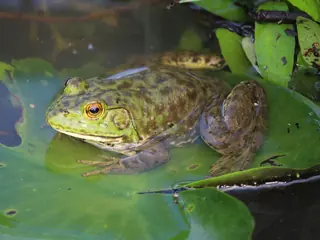 | American Bullfrog introduced Lithobates catesbeianus Ranidae | 8.0 in (203 mm) body | 73% | day and night | 434 |
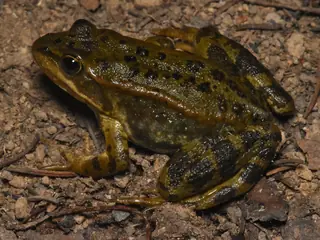 | Columbia Spotted Frog Rana luteiventris Ranidae | 3.5 in (90 mm) body | 48% | day and night | 252 |
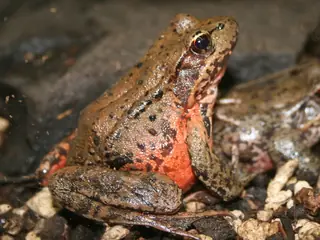 | Northern Red-legged Frog Rana aurora Ranidae | 5.2 in (131 mm) body | 31% | 1,030 | |
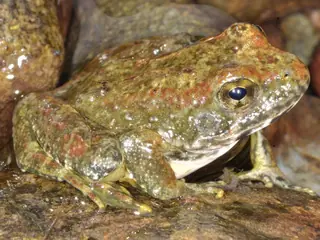 | Foothill Yellow-legged Frog Rana boylii Ranidae | 2.9 in (73 mm) body | 23% | 542 | |
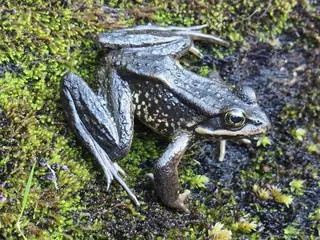 | Cascades Frog Rana cascadae Ranidae | 3.0 in (75 mm) body | 22% | 949 | |
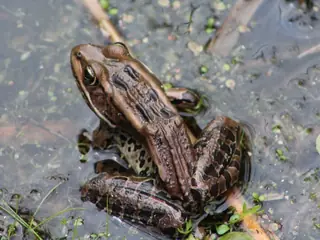 | Northern Leopard Frog Lithobates pipiens Ranidae | 6.5 in (165 mm) body | 13% | 67 | |
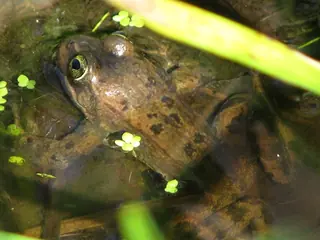 | Oregon Spotted Frog Rana pretiosa Ranidae | 3.9 in (100 mm) body | 7% | day | 732 |
Share of Oregon is the part of the state inside the species' USGS range map. Size is the largest on record where the source gives a maximum, otherwise a typical adult. Records are open-licence observations and specimens in the state; a blank means none were counted, not that the species is absent. "Recorded" marks a species with no USGS range here that open records place in the state (ten or more, in three or more years).
Other groups in Oregon
True frogs in nearby states
Sources
- AmphiBIO v1. CC BY 4.0. Read 2026-11-15.
- GBIF Backbone Taxonomy. CC BY 4.0. Read 2026-11-15.
- GBIF occurrence records under CC0 and CC BY 4.0. CC0 and CC BY 4.0 per record. Read 2026-11-16.
- US Census Bureau cartographic boundary files 2023. Public domain (US Census Bureau). Read 2026-11-15.
- USGS GAP 12-digit hydrologic unit range units. Public domain (USGS). Read 2026-11-15.
- USGS Gap Analysis Project Species Range Maps CONUS_2001. Public domain (USGS). Read 2026-11-15.
- iNaturalist photographs under CC0 and CC BY. CC0 and CC BY per photograph. Read 2026-11-15.
How each figure is derived is set out on the methods page.